Monday, August 30, 2010

You know who I am really really disliking right now....This Guy...(see Picture below)

"This Guy" who goes by the name of Brett McCracken
That viking imitating bearded man you see there....Last name: MCracken. Well he's kind of a big deal right now (or he has a really really good publicist). He has a book coming out (maybe it's already out), called Hipster Christianity. And it's about the recent trend of Churches and Christians attempting to blend Christianity with  what is "hip" in order to have church marketed as relevant,  in order to make church more appealing to the lost.

I'm not going to read it.

Because if you click this link here,  we get an article by McCracken that seems to serve as an overarching summary of what he is getting at in his book.

And he spends a good 75% of the article ripping any recent attempts for churches to market themselves as relevant in the past few years (which he said the trend was birth out of the now dead "emerging church" movement).

Fine. Good. I see what you're doing here McCracken. We shouldn't be marketing Christ.

AMEN!

But McCracken, what do you suppose as a solution instead of attempts to be relevant?

(In his own words that are in the article):

"If the evangelical Christian leadership thinks that "cool Christianity" is a sustainable path forward, they are severely mistaken. As a twentysomething, I can say with confidence that when it comes to church, we don't want cool as much as we want real.


If we are interested in Christianity in any sort of serious way, it is not because it's easy or trendy or popular. It's because Jesus himself is appealing."

That's it? That's it McCracken? Your answer is Jesus?
You can't be serious?
(I think he's serious). 
Which Jesus is it you're referring to then? 
Scorsese's insane, marrying Jesus in Last Temptation of Christ Jesus?
Gibson's Catholic Jesus in Passion of the Christ?
Pausolini's ethical Jesus in the Gospel of Matthew?
How about the crowd favorite, of Swedish, blue-eyed Jesus in the Greatest Story Ever Told?
Maybe it's clown Jesus in Godspell?

Wait...McCracken...you can't be...no....my goodness...you're crazier than I thought man....
This is the Jesus you're talking about?


You mean to tell me McCracken, you are referring to crucified Jesus as appealing?
You're nuts. Sure that means our sins are forgiven, but you can't think about Jesus like that without realizing that our call here on earth is the same, all that "he that loses his life will find it" stuff, that whole "pick up your cross and follow me" bit. Yeah, that's real appealing McCracken.
If I wasn't such an ethical man and one who abides by a faith commitment, I would say that McCracken is ripe to be put in a parade of clowns and himself as the grand marshall, dressed up just like he is with a banner that goes before him saying "Brett McCracken, Church Jester: Buffoon." And he will be in handcuffs too (or maybe a Chinese finger trap?).
To you, dear reader
So you may be wondering why I am so harsh on our bearded man. Mind you I am this frustrated, and I haven't even read the book (just a small essay by him)...
Here's the deal:  First off, this guy is saying we don't want relevant, we want real. And everyone's going around promoting this "real" Christianity or "authentic" Christianity (no harm meant whatsoever towards any churches that carry said labels as their church names). But no one's dared to define what real Christianity or authentic Christianity is that makes Christianity so much more tangible and concrete than any other churches that do not promote being "real." Until someone produces a concrete definition of what "real" or "authentic" is that makes this "non-fake" brand so appealing, and that allows us (potential consumers/potential competition) to anaylze/scrutinize/praise what they stand for.
 The way I see it, they stand for absolutely nothing. And I am willing to bet that when we can kind of grasp what "real Christianity" is, it will itself just be one more marketing ploy. 
This is how I read the McCracken article: 
Darkened rooms: Fake!
Pastor who looks hip with relevant haircut: Fake!
Church that brings out Sex as a theme: Fake!
And then finally: It's all marketing! Instead, let's "Be Real." (what's real?) "Jesus: Good."
 I myself don't mind McCracken as a critic. Most of the stuff he mentions, I am annoyed by. But just because I don't like those methods doesn't mean I would dare call their Christianity fake. But McCracken is part of the growing voice in Christianity that is reacting against attempts to change the definition of church (sometimes slightly, sometimes with an overhaul). This voice is that of some weird unearned exceptionalism that for some reason thinks their OWN version of church (which is probably just embedded into an older brand of Christianity that appealed to their culture from decades ago) is "real." As Peter Berger, a renowned sociologist and devout Christian pointed out, that ever since protestantism broke onto the scene, each church and religion is apart of a marketing ploy to outcompete their competitors (other church/religion). Even if one defines their church as being anti-marketing, and therefore traditional, that too is a marketing tool to appeal to the Christians who are so turned off to the proactive marketing schemes they see in "relevant" churches. 
I guess in summary, this whole "real" Christianity thing is so frustrating because it acts like it's above all of the noise of desperate churches trying anything and everything to reach the lost (some it good, some of it bad) when real christianity itself is embedded into a culture trying to be relevant to to that culture (even if the culture it is trying to relate to is anti-modern culture) and therefore waist-deep with all of the rest of Christianity in trying to figure out how to maintain the careful balance of trying to appease the times, but without abusing the purity of Christianity (what is essential? What can go?). In other words, Real Christianity stands against many things, but seems to stand for nothing for itself other than "Jesus" which can be an entirely abstract and vague idea itself. It is no better than us. It is one of us. Even if their "being real" is claiming that it is against the rest of us.
And the biggest irony for McCracken....His book is being actively marketed and promoted and sold to  Christians, in a format that is... entirely relevant. Look no further than his website. (it looks like all the music blogs I visit). Actually when I come to think of it...it's kind of cute in a sad way. Like a puppy dog trying to bite the fingers off it's owner with it's harmless baby teeth (although they can slightly sting sometimes). The owners fingers, which feed the puppy  daily and try to take it on a walk.

Quote of the Day

"All human beings are equal, but all cultures and religions are not. " -Hirsi Ali

Don't believe her? Compare all the scientific achievements of the Mayans with that of the Ancient Greeks. Despite their incredible knowledge, the Mayans created a culture of killing and human sacrifices, where no one was sacred. We're still feasting on the philosophical and artistic riches of the Greeks, along with the seedbed of democracy. History continues to show us that all cultures are not equal.

Quote courtesy of Big Questions Online.

Thursday, August 26, 2010

Hello, My name is Joel and I'm a Narcissist....

Caption: I tried getting a picture of Narcissus looking at his reflection in the mirror but for some reason Google images was causing my browser to crash so I settled for a picture that I drew of myself (what'a better example of narcissism?)


This link describes a bit of a war amongst social scientists over exactly how egotistical Generation Y is. And the argument goes something like this: Generation Y (or the Millenials) "born after 1970 are more likely than previous generations to see themselves as “an important person,” to say they’re confident and rate their self-esteem higher. 'The research converges on this: that individualism is increasing, that it’s more acceptable in the culture to focus on oneself, and not to worry so much about social rules.'" The author of this quote (Jean M. Twenge) is also the author of a book Generation Me which as you guessed it, the book title is the name she gives this aforementioned generation full of egotistical, attention seeking, self-obsessed, individualist nitwits. A generation which the author of this article (who has become so egotistical that he has decided to refer to himself in the third person) proudly claims himself as not only a founding member, but also a customer. And disappointingly, Jean Twenge is not a bitter old lady looking to get back at those ragamuffins who keep prank calling her while she is sleeping at 11 PM on weekends. Rather, Jean Twenge as if to flaunt her own, individualistic self, is also a member of this "Me" generation.

But that's not to say, that her research is without controversy. Because quite possibly the people of the "Me" generation she was interviewing were just from an overly represented demographic amidst the generation. Basically Jean Twenge could only find middle-class and upper-middle-class white kids whose chief character attribute is a sense of entitlement at the University which she conducted her research. This amongst several other criticisms have kind of softened the blow of Twenge's accusations. The opposing social scientists argue that what Twenge is calling an egotistical generation is actually more indicative of interviewing and surveying kids that are at an egotistical age in life. In other words, kids are most prideful and arrogant and self-absorbed in their late teens and early twenties, right when Twenge was interviewing them. So this whole "the younger generation is so much worse today than my generation was when we were that young" rhetoric may actually be rather understood as "the reason I didn't think my generation was bad when I was younger was because we were the age which ego lived the loudest and now that we are older and humility has taken hold, we now frown upon the age group that reflects the egotism that we once were apart of, but never self-aware enough to recognize it."

My thoughts: I never have really bought the whole "the world is falling apart" more and more as each generation succeeds the previous kind of thought process. If that was the case, the ancient Romans must have been absolutely divine in their behavior but when compared to our generation, the reality is we look like angels compared to the behavior of the ancients.

But on the other hand, I think social networking has provided the tools to accentuate our narcissistic tendencies way more than any other generation previous has had an opportunity to do. I don't necessarily think we are worse than previous generations, but rather facebook and the like offer the opportunity for ego in it's fullest, most heinous form to devour the souls of self-obsessed young people everywhere served up on a buffet for the criticism of on-lookers of the older generations (the author of this article easily acknowledges that by taking the said position, he is playing into the criticism of his generation as being narcissistic).


The Worst Part is the author of the article scored masterfully on the quiz in terms of achieving a 19 which had my narcissism above even the average celebrity and recommended I get checked to see if I have Narcissistic Personality Disorder.*


*The author could launch into a long rant about how he felt the quiz was poorly written and not effective in it only being an either/or style of quiz. He could also point out that the reality of the situation was that he filled out the quiz once but when he clicked submit Google Chrome crashed as to not give him the results and so he set upon taking the quiz again and when that happened he noticed that he was putting in different answers than he did the first time and in both cases he felt he was being equally honest in each and therefore the 19 that he received on the Narcissism quiz was more a reflection of bad timing and Google Chrome processing the wrong quiz results than it was an accurate reflection of his personality. But if he were to rant as so he fully acknowledges that he would be playing into the same case of narcissism to which he stands accused of and thus in an aim to rehabilitate himself from his crippling condition (to which he is just a victim of his times), he will refrain from such a self-justifying rant.

Sunday, August 22, 2010

You know....he may have a point

Bruce Feiler has been a thorn in my side for some time now. When people want to know about the interfaith movement, or ecumenical religion in it's most idealistic forms, I point them to Feiler. To get a good understanding of Feiler's viewpoint, read Abraham: A Journey to the Heart of Three Faiths which I find impractical, and more appalling in the fact this the book came after 9-11 which I thought was the ultimate symbol that the ecumenical "all roads lead to Heaven so let's love each other and our different religious perspectives"  mindset that was preached so dogmatically in the 90's has no place in the real world.

However, in today's article of note, Feiler's push for an embrace of all perspectives is secondary to some interesting points that I had never heard:

-In 1860, in the midst of tensions surrounding the Civil War, it was widely believed in the United States that Abraham Lincoln was Catholic. Coming on the heels of decades of anti-Catholic sentiment, the rumors seem to have had two roots: The first was the ambiguous nature of Lincoln's upbringing in Illinois, where Jesuits were very active, leading to the notion that Lincoln had been baptized a Catholic; the other was that Lincoln represented a prominent critic of the Church. The rumors were widely repeated by Lincoln's political opponents.


-In 1940, in the midst of tensions surrounding World War II as well as economic hardship from the Great Depression, it was widely believed in the United States that Franklin Roosevelt was Jewish. Coming on the heels of decades of anti-Jewish sentiment, the rumors seem to have had several roots: The first was the ambiguous origins of Roosevelt's earliest American ancestors, who came from Holland in the 17th century; the second was the abundance of Jewish appointees to Roosevelt's administrations in New York and Washington. The rumors were widely repeated by Roosevelt's political opponents.


And then all of this to establish Feiler's main point which I happen to agree with:


-In 2010, in the midst of tensions surrounding wars in Iraq and Afghanistan as well as economic hardship from the Great Recession, it is widely believed in the United States that Barack Obama is Muslim. Coming on the heels of decades of anti-Muslim sentiment, the rumors seem to have had several roots: The first is the ambiguous nature of Obama's upbringing, in which his father was a Muslim and he spent formative time as a child in a Muslim country; the second is Obama's vocal outreach to the Muslim world and his support of the rights of Muslim Americans. The rumors have been widely repeated by Obama's political opponents.


Now it is probable that there are some nuances that Feiler is avoiding that would complicate his point, but overall it should give one a second thought about what exactly this whole "Obama is a Muslim" debacle is about.


Wednesday, August 18, 2010

Gospel in Kenyan Nightclubs

Alert reader John pointed us toward NPR's feature on how an African worship song is lighting up the nightclubs of Kenya! They also speak glowingly of the contemporary worship in the churches that are springing up there.

As one of the comments shared: "Rough summary... "when things are going well and when they aren't, praise the Lord and... TOBINA! (DANCE!!!!)" Man, If this is what it means to worship, Is it any wonder that churches in Central Africa are growing! Who needs the clubs? Let's go to church!"

Take a listen to the feature, then watch the music video:

Tuesday, August 17, 2010

Creativity + Passion = Impact

Maybe he thought he was ordering an ice cream cone, but instead he got a hilarious lesson in showmanship.


Via BoingBoing.net.

Monday, August 16, 2010

Inform Yourself: Social Networking and You

So today, I became spontaneously curious about social networking theory. I don't know why. I don't even know if I knew something called social networking theory existed. But within minutes I was scanning several articles of interest that basically are all getting to the question, "But what does it all mean?" "What can social networking tell us about ourselves?"

Well from what I have read, academia is just scratching the surface about the implications of social networking and what exactly it is, what it means, and how it happens.

More appropriately, we just have a bunch of scholarly speculation of what exactly is going on.

One of my favorite articles, although from 2008 came from one of my favorite authors, Stephen J. Daubner, co-author of Freakonomics fame.

In the article which can be seen here, Daubner e-mailed several scholars from several different fields this question: "Has social networking technology (blog-friendly phones, Facebook, Twitter, etc.) made us better or worse off as a society, either from an economic, psychological, or sociological perspective?"


The answers, for the most part consisted of admitted speculation. But there were a few interesting quotes and perspectives amongst the bunch. Here are some of my favorite,


"students were using Facebook to increase the size of their social network, and therefore their access to more information and diverse perspectives. "


"Talk is cheap. Anyone can post “u r cool” on someone’s “wall,” or “poke” them on Facebook, but genuine smiles and laughs are a much more reliable indicators of someone’s suitability as a faithful friend."


"I remember one day a few years ago when our office phones and Internet stopped working. No e-mail, no voicemail, no Facebook, no Skype, and no Twitter. People came out of their offices and talked. I enjoyed that day."


"Powerful new technologies provide great benefits, but they also change the way we live, and not always in ways that everyone likes. An example is the spread of air conditioning, which makes us more comfortable, but those who grew up before its invention speak fondly of a time when everyone sat on the front porch and talked to their neighbors rather than going indoors to stay cool and watch TV. The declining cost of information processing and communication represents a powerful new technology, with social networking as the most recent service to be provided at modest cost. It can be expected to bring pluses and minuses."


"social networking technologies support and enable a new model of social life, in which people’s social circles will consist of many more, but weaker, ties. Though we will continue to have some strong ties (i.e., family and close friends), demographic changes, such as frequent household moves and the replacement of friends and family with market services for tasks such as daycare, are diminishing the role of social ties in everyday life. Weak ties (e.g., casual acquaintances, colleagues) may not be reliable for long-term support; their strength instead is in providing a wide range of perspectives, information, and opportunities. As society becomes increasingly dynamic, with access to information playing a growing role, having many diverse connections will be key.
Social networking technologies provide people with a low cost (in terms of time and effort) way of making and keeping social connections, enabling a social scenario in which people have huge numbers of diverse, but not very close, acquaintances. Does this makes us better as a society? Perhaps not — we can imagine this being a selfish and media-driven world in which everyone vies for attention and no one takes responsibility for one another. But perhaps it does — we can also imagine this being a world in which people are far more accepting of diverse ways and beliefs, one in which people are willing to embrace the new and different."

Thursday, August 12, 2010

On the transformation of the state our expecatations of a pastor within our church

What do we want in a pastor?

Fascinating op-ed in the New York Times from a pastor about how church goers want an entertainer for a pastor, one who "keeps sermons to 10 minutes, tells funny stories and leave people feeling great about themselves."

No longer do church saints want the pastor say what he needs to to improve us as Christians to better serve the world.

Of course, as apostolics, I don't think this is an immediate concern because I only can see hints of it present in our movement (it seems to be more of an issue in non-apostolic churches where the line between church as entertainment and worship has been greatly skewed), but I can't help but wonder if this will be the dilemma for us in 20 years as the role of pastor is constantly transforming....

Tuesday, August 10, 2010

Rethinking academia....


Check out this thought provoking interview with Andrew Hacker, co-author of a book titled Higher Education, which argues that the college and university system needs a drastic overhaul. At the heart of the problem is the lust for tenure by professors and colleges emphasizing research with their professors over professors having an actual ability to teach students.

In the interview itself, the author has other suggestions including that one need to get a liberal arts degree for undergraduate study instead of vocational training which made me feel all warm inside of re-affirmation about my existence because I am usually the one ashamed to say my major was political science when the real money was majoring in some kind of engineering.

Of course, the my real love for the author of the book came out when he was comparing Ohio State and their love for football with a lack of emphasis on academics in contrast with their rival school up north, " Michigan is actually a much better university than Ohio State—its reputation, its medical school, its law school, and so on. It makes you wonder whether Ohio is putting so much into its sports teams because its academics really aren't so great. "

As a University of Michigan alum, and without any bias whatsoever, I happen to agree with Hacker's observation.

Wednesday, August 04, 2010

Your "awwwwww isn't that cute?" moment of the day


yeah it's that cute....

Tuesday, August 03, 2010

You may not be able to see this tomorrow...

So, yesterday a sun explosion happened the size of the earth and further a much bigger reaction on the sun. This impacts how? Well the explosion is directed straightway for the earth. Which means the results of the explosion of the sun tsunami could hit earth as early as today and as late as tomorrow. What this means is anyones guess....

Most likely a few satellites get put out of commission and the magnetic pulls get thrown off a bit, and Britain may be getting the worst of it....

The good news is that if speculations are correct, we are going to have some awesome night views of the sky....

read more about it here....

Monday, August 02, 2010

Why you are not rich, and they are....

So in today's link, we get an article about the "Founder Institute" which conducted a survey to entrepreneurs about entrepreneurs to try and uncover what attributes will determine success amongst beginning entrepreneurs (yes I just used "entrepreneur" three times in a sentence so i can get in the habit of spelling it correctly).


The three defining attributes that were indicative of a successful entrepreneur in contrast to entrepreneurs that will fail:

  • Openness (willingness to try new things)
  • Fluid Intelligence (ability to quickly assimilate new information)
  • Age (older the age the more likely they are to stick with a project)
All that is well and good.

I approve of whatever banner they are supporting in their endeavors..

But here's the schtick to me....

Those three defining terms...

Aren't they a bit arbitrary or is that just me?

Like when I read those three points, my brain immediately evaluated myself and went something like...

"Openness? I am open as open can be. I hate monotony and am always ready to experiment" CHECK!

"Fluid intelligence? My whole brain is fluid! I am always reading and trying to incorporate what I have read into my world view." CHECK!

"Age? Okay maybe I'm not young, but understanding age is just a correlation to the bigger attribute of staying dedicated and loyal to a project, I'm sure I could qualify."

I MUST THEN BE AN ENTREPRENEUR, and a successful one at that!

I know my logic is completely off....but that irrationality is present in most human beings (I being one of them), and I feel like in the process of the research to define the successful entrepreneur, the Founder Institute didn't define much at all, other than the fact that they had to show results for the work they were doing and they threw out two terms ("openness" and "fluid intelligence") which are very gray in their definition, and then the third ("age") is concrete, but surely one overlooks the concreteness of that term in favor of the two more subjective terms used in order that all can say, "I am open and fluid and therefore I will start a company next week."

I am sure my criticism would be well-answered by the institute itself  such as my critique of the subjectivity of the two terms can be made more concrete by asking the right questions in the survey (and some of it is answered in the article), but for the average reader, this survey causes nothing but more self-deception in my mind, thinking it is I who could be the next Mark Zuckerberg.

Wednesday, July 28, 2010

Answering the Neo-Atheists

Just because the smart atheists get more press than the brilliant Christians doesn't mean they aren't out there fighting the good fight. In fact, I'd argue the media is hungry for smart Christians who are willing to argue over subjects besides theology.

Case in point: Novelist Marilynne Robinson. The Sunday Times of Britian calls her the finest novelist of prose today (they ought to know), but she's quite adept at arguing science as well. Her latest book, Absence of Mind, is a collection of lectures on the problems with neo-atheism that is getting respectful-to-rave reviews as she dismantles their arguments while also proclaiming the reality of a living God.

The National (from the UAE) states:
"Likewise, Robinson argues that the materialist case for “reductionist” views of human consciousness and life hinges largely on a gross caricature of religious ideas and “the exclusion of the testimonies of culture and history”. It’s striking, Robinson observes, that the case against religious belief has remained so essentially stagnant since the rationalists of the 18th century began to depict faith as a primitive superstition, a fearful retreat from the cold, hard facts of life. This portrait, she writes, “resembles nothing I have come across in my nonspecialist perusals of the last five hundred years”. To the contrary, she says, religious thinkers going all the way back to the 4th-century Christian theologian Gregory of Nyssa have contemplated “the ontological unlikeness of God to the categories to which the human mind has recourse is at the center of theological reflection” –they have, in other words, tarried with the unknowable rather than retreated.

Canada's Globe and Mail tells us:
The power of imagination that makes a novelist seldom goes together with the analytical abilities needed to be a philosopher. George Santayana wrote The Last Puritan (1935), a bestseller and also a fine novel, but in this as in many other respects the Spanish-American philosopher was highly unusual. There have been very few novelist-philosophers, and in recent times most of that small number – the business-class Nietzschean Ayn Rand, for example – have been noteworthy for the childishly primitive quality of their thinking.

One of the great writers of fiction, Pulitzer Prize-winner Marilynne Robinson (for Gilead, in 2005) may be the only living novelist who has made a genuine contribution to philosophical reflection. Comprising four closely reasoned and richly imaginative chapters based on a distinguished lecture series at Yale, Absence of Mind is one of the most thought-stirring inquiries into fundamental questions that has appeared in many years.


The Globe & Mail also offers a fascinating interview. Be sure to read the comments, as the critics accuse her of delusion without much engaging this point, for instance:

G&M: You seem to fault the likes of Richard Dawkins and Daniel Dennett for a failure of imagination, for failing to grasp complex individual behaviours of the sort that had us thinking about gods, or first causes, to begin with. Though they do construct stories, they're stories that seem to discount subjective experience in favour of an overarching master narrative. Is this a novelist's criticism of the scientific mind?

MR: I am a great admirer of the scientific mind. I may have a special definition, one that ranks physicists and cosmologists very far above entomologists, animal anthropologists, linguists. I believe Dennett is a philosopher, which puts him off the scale altogether. I love grand hypotheses. I love the excitement that runs through any real (by my definition) scientific community when something is observed that overturns established assumption. New thinking is precisely what is never found among these new atheists. All their books repeat one argument, which could have been written in 1890. Their emendations, for example that famous “selfish gene,” are conservative strategies for shoring up old ideas. There is rarely a hint that they proceed from data or observation, and never a sign that anything can surprise them. Dogmatists are not given to flights of imagination or to the creation of new syntheses. Scientists are. The human mind, wonderful and terrible, is the great fact. To minimize its power, its complexity, its loneliness and radical individuation, is to evade every essential question.


If you want accessible Robinson, try out her Orange Prize-winning Home. If you want lyrical Robinson, try her Pultizer Prize-winning Gilead. If you want a dense but absorbing read, read Absence of Mind - it'll make you proud of another smart, articulate Christian.

Tuesday, July 27, 2010

This may not be the place to say it.....But i'll say it anyways

I found my future wife. Okay, maybe I didn't find her. But i found just one more prerequisite for her to gain my affection (if she is ever to come) . It's that she must love Flannery O'Connor.

Usually this blog is about contemporary issues. Well this post, is a 1940's and 50's issue. You see two weeks ago, I was reading a book that dedicated an entire chapter to Flannery. I was familiar with the name (and had thought She was a He up until that chapter), and saw that she was primarily a short-story author and a Christian who aims to find grace in the most wretched corners of existence.

I was sold.

The first short story I read was her most famous, "A Good Man is Hard to Find."

I read the story for a half hour.

I then literally sat after the story was over stunned for a good hour to two reflecting on the story and it's implications (I have since spent another three hours or so in various conversations about it).

Needless to say my life would never be the same. But every time I mention O'Connor to someone now, the one's who have read her go "duh!" As if they were living their entire existence under the assumption that the entire world had read Flannery because it was a prerequisite to ever live.

But no one told me, and thus I had to stumble through the first 24 years of existence in ignorance of her writing.

So I shout to you dear reader as to not offend my own ethic, if you have any analytical skills in regards to literature whatsoever, read Flannery O'Connor as soon as possible (note that I have been living off of Flannary in the few short stories that are available online. Most seem to be only available in print because of copyright law).

(And i apologize that this was a literature post on a blog that really doesn't focus on such a category at all).

Saturday, July 24, 2010

The American Scholar Rocks!

I love poking through the magazine shelves of the local book superstore because there's always treasure to be found. At present, it's The American Scholar, a tough-minded left-leaning quarterly that doesn't flinch from covering academic, political, literary, and religious topics from unpopular vantage points if the facts undergird it. This issue has just about everything:

  • The cover article declares: "The Earth Doesn't Care if You Drive a Hybrid," while Robert B. Laughlin talks about current climate issues through the lens of geologic time--and comes up with some surprising insights:
"Common sense tells us that damaging a thing (Earth) this old is somewhat easier to imagine than it is to accomplish—like invading Russia. The earth has suffered mass volcanic explosions, floods, meteor impacts, mountain formation, and all manner of other abuses greater than anything people could inflict, and it’s still here. It’s a survivor. We don’t know exactly how the earth recovered from these devastations, because the rocks don’t say very much about that, but we do know that it did recover—the proof of it being that we are here."
  • Poet Christian Wiman, who grew up Southern Baptist before turning to atheism before returning to a full-fledged faith, writes about "Hive of Nerves," which is described as: "To be alive spiritually is to feel the ultimate anxiety of existence within the trivial anxieties of everyday life." I heard his presentation on this topic at Calvin College's Festival of Faith and Writing, and it was candid, penetrating, and reaffirming.
  • An essay on how the writers of the early-to-mid 19th century struggled to find who Americans actually were. Then they foundthe unique literary voice of America.
  • New fiction by short story master Charles Baxter.
If you've never braved an academic quarterly, this is the one to start with. You won't regret it.

Thursday, July 22, 2010

Conspiracy or Reality?

So before I give the following link, know that I can't stand conspiracy theories. I find them absurd and more so built in order that people may provide order and explanation to seemingly simply absurd tragedies. In other words conspiracy theories are wrought out of a desire to bring order to the tragedy of chaos.

19 foreign Muslims getting together and hijacking 4 planes and wreaking havoc on an entire nation by bringing down 3 of the country's most beloved structures and killing thousands in the process doesn't make as much sense as claiming the government orchestrated the events.

But that said in my aimless web browsing last night i came across a link that I initially laughed at because of it's absurd allegations of conspiracy. In short, Google and the government are in cahoots to maintain control of the internet. Joseph Lieberman even has a bill in the house right now that allows for the government to put a freeze on the internet during wartime. I assumed I was reading conspiracies of a madman. But the dude has some legitimate evidence and there are countless articles he points to that seem to make things a little erie. I have not made any conclusions whatsoever, and will retain skepticism. But the paranoia of Big Brother grew a little bit in me last night.

Read the link here 

Wednesday, July 21, 2010

Tweet

I generally hate poetry. It's too abstract for me. However, through high school and college there were a few poems here and there that really woke me up at the awesome power of poetry and how it can reach places in our soul that would otherwise have been left hollow drab.

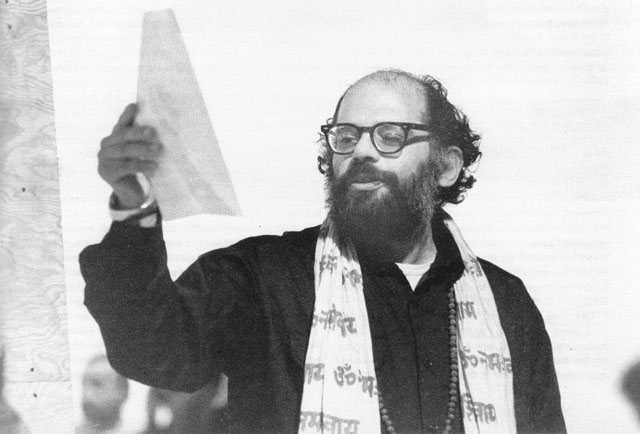
"Howl" by Allen Ginsberg (pictured) was one of those poems which did captivate my soul. It had me at it's very first line, " I saw the best minds of my generation destroyed by
              madness, starving hysterical naked"...

Last week I read a redux of the poem except with my generation in mind and it's dependence on technology.

Read it here. I hope you like it as much as I do.

Monday, July 19, 2010

Young Jesus Chronicles

"He gets if from his Father's side."


Strolling through a nearby B&N, I came across a book of one-panel comics called The Young Jesus Chronicles. Mostly good-natured spoofs of famous moments in Scripture, or current society, it's quite funny. Yes, they overplay a couple themes, but the payoff is still quite large as you thumb through the book.

Take a look!

Saturday, July 17, 2010

Walter Hawkins RIP


Gospel Great Walter Hawkins died earlier this week. The New York Times captures the mood well in their obit.

You can't listen to his Love Alive (with the unmatchable "Goin Up Yonder") and Love Alive II albums without getting goose bumps.

Public Airwaves: Taking the Lord's Name in Vain


NPR argues back and forth for allowing the Lord's name to be taken in vain on the public airwaves.

What's especially interesting is how sensitive they are to complaints from listeners. (The article references one - and only one - caller complaining in CT.) If we make efforts to call or email, they take that very seriously.

Another example of staying alert to our responsibilities as Christians.